Introduction – Beyond the High-Tech Look
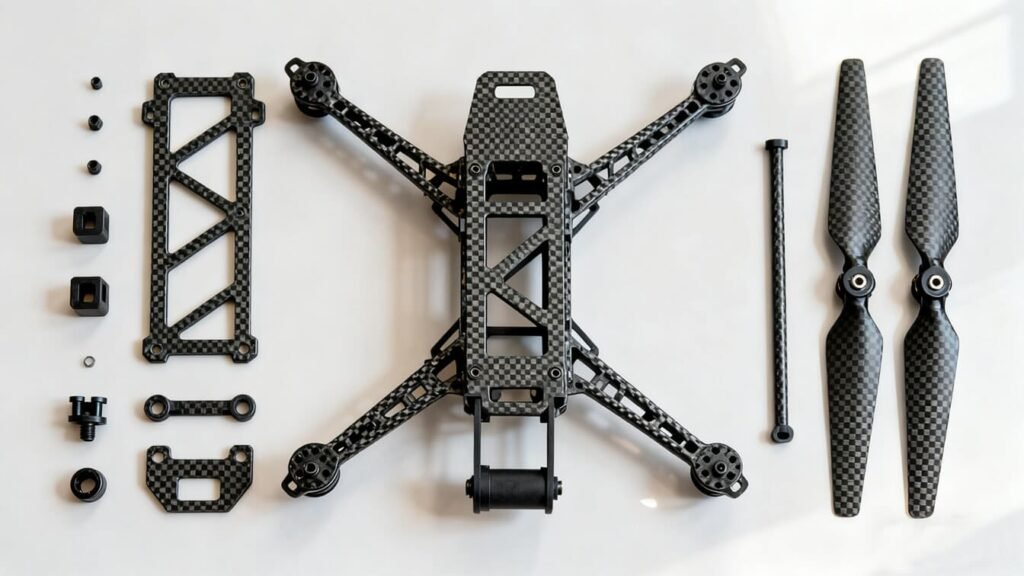
When you see carbon fiber, the first thing you notice is its look. That distinctive, often diagonal pattern has become a universal symbol of strength, light weight, and advanced technology. It adorns everything from Formula 1 race cars to high-end bicycle frames and luxury watches. But that captivating pattern is far more than just a cosmetic choice. It is the visual result of a carefully engineered structure, and the specific weave is fundamental to the material’s performance.
The way the carbon fibers are interlaced is a science in itself, a meeting point of textile principles and advanced material engineering. The choice of weave can make a component incredibly rigid, surprisingly flexible, or immensely strong in one specific direction. It determines how a part will handle stress, how it can be molded into complex shapes, and ultimately, how it performs in its final application.
This guide is designed to take you on a deep dive into the world of carbon fiber weaves. We will demystify the technical jargon, break down the science behind each pattern, and provide you with the practical knowledge to understand why one weave is chosen over another. From the basic building blocks of the fabric to the most exotic patterns, you are about to become an expert on what truly makes carbon fiber tick.
The Building Blocks of a Weave
Before we can understand the different patterns, we need to get to know the “thread” itself. Carbon fiber fabric isn’t made from a simple strand; it’s constructed from highly engineered bundles of microscopic filaments.
From Precursor to Filament: The Microscopic Origin
Every carbon fiber begins its life as a polymer precursor, most commonly a material called polyacrylonitrile (PAN). Through a complex, multi-stage process involving intense heat and stretching in an oxygen-free environment—a process known as carbonization—all the non-carbon atoms are burned away. What remains are incredibly thin filaments of nearly pure carbon, each one many times thinner than a single human hair but boasting incredible tensile strength.
Tows and K-Grades: The “Yarn” of Carbon Fiber
A single, microscopic filament is not very useful on its own. To create a workable fabric, thousands of these individual filaments are gathered together into a bundle, which is known as a “tow.” This tow is the fundamental “yarn” used to weave carbon fiber cloth.
You will often see carbon fiber described with a “K” number. This is a simple grading system that tells you how many thousands of filaments are in each tow. The “K” literally stands for one thousand.
- 1K: Each tow contains 1,000 carbon filaments.
- 3K: Each tow contains 3,000 carbon filaments.
- 6K: Each tow contains 6,000 carbon filaments.
- 12K: Each tow contains 12,000 carbon filaments.
The K-count has a direct impact on the final fabric. A 3K tow is physically smaller and thinner than a 12K tow. Consequently, a fabric woven from 3K tows will have a smaller, tighter-looking pattern and will generally be thinner and lighter than a fabric woven from 12K tows, which will have a larger, bolder-looking pattern.
Warp, Weft, and Crimp: The Language of Weaving
To understand the patterns, it helps to know three basic terms from the world of textiles that apply directly to carbon fiber:
- Warp: These are the long, continuous fibers that run the entire length of the fabric roll. They provide the fabric’s longitudinal structure.
- Weft: These are the fibers that are woven from side to side, passing over and under the warp fibers to lock them together.
- Crimp: This is one of the most important concepts for performance. Crimp refers to the small bends or waves created in the fibers as they interlace with each other. A fiber with high crimp has many sharp bends, while a fiber with low crimp is much straighter. This is critical because **less crimp generally equals higher strength.** A straight fiber can resist a pulling force more directly and efficiently than a wavy, crimped fiber, which must first straighten out before it can carry the load effectively.
The Major Weave Patterns: A Deep Dive
Now that we have the building blocks, let’s explore the primary weave patterns. Each one offers a unique trade-off between stability, flexibility, strength, and appearance.

Plain Weave (1×1): The Stable Workhorse
- Description: The plain weave is the most basic pattern. It features a simple, symmetrical one-over, one-under interlacing, creating the appearance of a small checkerboard.
- Properties: Its main advantage is high stability. The frequent interlacing locks the fibers tightly in place, so the fabric resists distortion and is easy to handle during the manufacturing process. However, this tight weave also creates a high degree of crimp, which can slightly reduce its theoretical maximum strength compared to other weaves.
- Drapability: This weave has low flexibility, or “drapability.” It does not conform well to complex, curved shapes and is best suited for flat panels or simple 2D curves.
- Best Use Cases: It is excellent for flat structural panels, tooling, and any application where maintaining a perfect fiber orientation is more important than conforming to complex shapes.
Twill Weave (2×2, 4×4): The Iconic All-Rounder
- Description: The twill weave is the most famous and widely recognized carbon fiber pattern. It is created when a weft tow passes over a certain number of warp tows and then under the same number. The most common is the 2×2 twill, where the tow goes over two, then under two, creating a distinctive diagonal “V” pattern in the fabric.
- Properties: Twill weave offers a fantastic compromise between stability and flexibility. Because the fibers travel over a longer distance before interlacing (a longer “float”), there is less crimp compared to a plain weave. This results in a slightly higher strength profile and a material that is more pliable.
- Drapability: It has good flexibility and can be draped over moderately complex curves with relative ease, making it highly versatile.
- Best Use Cases: This is the go-to weave for a huge range of applications. It’s used extensively in automotive parts like hoods and interior trim, high-end sporting goods, motorcycle fairings, and any component that requires both excellent performance and the classic carbon fiber aesthetic.
Harness Satin Weave (4HS, 5HS, 8HS): The Contouring Specialist
- Description: Satin weaves take the concept of the twill weave’s “float” to the next level. In a satin weave, a tow will pass over multiple other tows before going under just one. For example, in a popular 8-Harness Satin (8HS), the weft tow floats over seven warp tows and then ducks under one.
- Properties: This structure results in very low crimp, allowing the fibers to lie almost perfectly straight. This gives satin weaves excellent strength properties. The major trade-off is low stability. The long, unsupported floats can easily shift and distort, making the fabric difficult to handle without care.
- Drapability: Its drapability is excellent. This is the best weave for conforming to highly complex, multi-contoured shapes without wrinkling.
- Appearance: It produces a very smooth, almost seamless, and highly reflective surface, as the interlacing points are far apart.
- Best Use Cases: Advanced aerospace components with extreme curves, such as winglets, fairings, and nose cones.
Unidirectional (UD): The Directional Powerhouse
- Description: Unidirectional isn’t technically a “weave” in the traditional sense. It is a type of fabric where all the fibers are aligned in a single, parallel direction. They are held in place by a very light stitching or a chemical binder.
- Properties: This material offers unmatched strength and stiffness, but only in the direction of the fibers. It has virtually zero crimp, making it the most structurally efficient form of carbon fiber for handling tensile loads. It is, however, very weak in other directions and can split easily along the fiber line.
- Drapability: It is not designed to drape over complex shapes. It can be bent perpendicular to the fiber direction but offers no flexibility along the fiber axis.
- Appearance: It has no distinct pattern and looks like a sheet of parallel black lines. For this reason, it is almost always used for the internal, structural layers of a part and is rarely seen on the surface.
- Best Use Cases: Unidirectional is the true workhorse of high-performance composites. Engineers use multiple layers of UD fabric, oriented at different angles (e.g., 0°, 90°, +45°, -45°), to build up a laminate that is strong and stiff exactly where needed. It is the primary material used in bicycle frames, aircraft spars, rocket components, and prosthetics.
Head-to-Head: A Comparative Analysis
Choosing a weave is a game of trade-offs. Let’s compare the primary options across the most important metrics to make the decision-making process clearer.
Strength, Stiffness, and Drapability
When it comes to strength, the general rule is simple: **straighter fibers are stronger fibers.** This means that weaves with less crimp have a higher potential strength. For a woven fabric, this places Satin at the top, followed by Twill, and then Plain. However, Unidirectional, with no crimp at all, is the strongest of all in its primary direction.
Drapability, or flexibility, is almost the inverse of stability. The looser the weave, the better it can conform to curves. This makes Satin the most flexible, followed by Twill, with the tightly-interlaced Plain weave being the least flexible.
The Ultimate Comparison Table
This table summarizes the key characteristics of each major weave type to help you see the trade-offs at a glance.
| Weave Type | Crimp Level | Fabric Stability | Drapability (Flexibility) | Strength Profile |
|---|---|---|---|---|
| Plain Weave (1×1) | High | High | Low | Balanced, but limited by crimp |
| Twill Weave (2×2) | Medium | Medium | Medium | Good balance of strength and flexibility |
| Harness Satin (8HS) | Very Low | Low | High | Excellent strength, low interlacing |
| Unidirectional (UD) | Zero | Very Low | Very Low | Maximum strength in one direction |
Exotic and Specialized Weave Patterns
Beyond the main four, the world of carbon fiber includes a fascinating array of specialized patterns, developed for either ultimate performance or unique aesthetics.
Forged Carbon: The Marbled Masterpiece
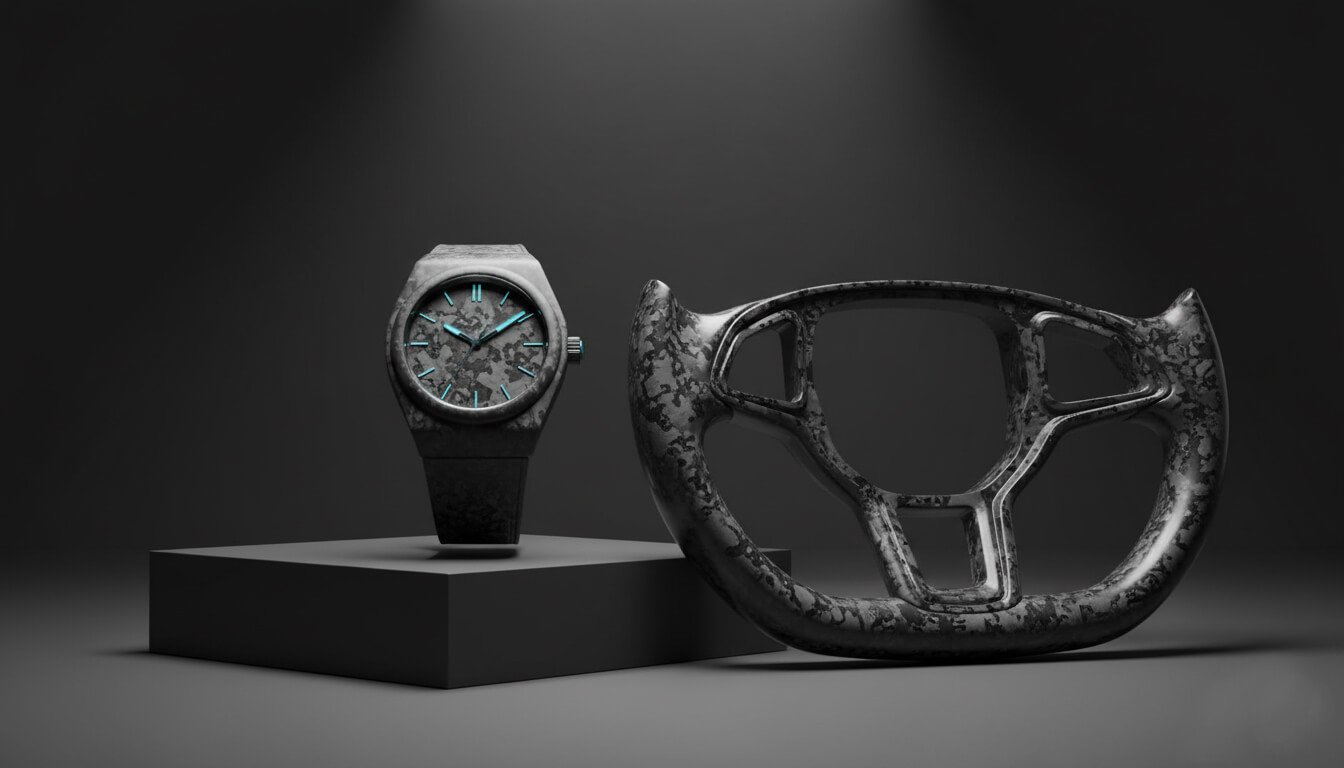
- Description: Famously popularized by Lamborghini, forged carbon (or more accurately, forged composite) is not a weave at all. It’s created by taking chopped carbon fibers mixed with resin and compressing them in a heated mold under immense pressure.
- Benefits: This process allows for the creation of incredibly complex, net-shape 3D parts that would be impossible to make with a traditional fabric. Because the fibers are randomly oriented, the resulting part has more uniform (isotropic) strength properties compared to a directional woven fabric.
- Appearance: It has a unique, marbled, or granite-like appearance that is completely random. No two forged carbon parts are ever exactly alike.
- Use Cases: Luxury automotive components, high-end watches, phone cases, and other designer goods where a one-of-a-kind look is desired.
Spread Tow: The Next Level of Performance
- Description: Spread tow fabric takes a standard carbon fiber tow and flattens it into a very thin, wide tape. These tapes are then woven, typically in a plain weave pattern.
- Benefits: By flattening the fibers, spread tow drastically reduces crimp, creating an almost perfectly straight fiber path within the weave. This results in a composite that is lighter (it uses less resin), stronger, and stiffer than one made from a conventional fabric. The surface finish is also incredibly smooth and flat.
- Appearance: A very distinct, large-scale checkerboard pattern that looks flat and clean, signaling ultimate performance.
- Use Cases: High-performance racing applications (Formula 1), professional cycling equipment, and lightweight aerospace panels.
Braided Weaves: Strength in the Round
- Description: Braiding is a process where tows are interlaced diagonally to form a seamless, continuous tube of fabric.
- Benefits: This structure provides excellent torsional (twisting) strength and great impact resistance. It’s the ideal way to create hollow, cylindrical parts with multi-directional reinforcement.
- Use Cases: High-performance drive shafts, bicycle frame tubes, pressure vessels, and other round structural components.
How Weave Pattern Impacts Performance and Stiffness
The choice of weave has a direct, measurable impact on the mechanical properties of the final composite part. Understanding this link is what separates a good designer from a great one.
The Critical Role of Fiber Orientation
As we’ve discussed, the direction of the fibers is paramount. The strength and stiffness of a carbon fiber composite are at their absolute maximum when the force is applied directly along the axis of the fibers (a 0° load). As the angle of the load shifts away from the fiber direction, the performance drops dramatically. A composite is at its weakest when the force is applied perpendicular to the fibers (a 90° load).
This is why the layup process is so important. By stacking multiple layers of fabric at different orientations—for instance, a sequence of [0°/90°/+45°/-45°]—engineers can create a “quasi-isotropic” laminate. This means the part will have good, balanced strength properties no matter which direction the stress comes from, mimicking the behavior of an isotropic material like aluminum but at a fraction of the weight.
| Fiber Orientation (vs. Load) | Tensile Strength | Stiffness (Modulus) | Behavior |
|---|---|---|---|
| 0° (Parallel) | Highest | Highest | Extremely strong and stiff, but brittle. |
| 45° (Diagonal) | Low | Low | Good for resisting twisting (torsional) forces. |
| 90° (Perpendicular) | Lowest | Lowest | Properties are dominated by the weaker resin matrix. |
Weave’s Impact on Impact Resistance and Failure
The interlacing of fibers in a woven fabric can also play a role in how a part handles impacts. The crossover points in a weave can act as tiny crack-stoppers. When a crack starts to form, it may be deflected or arrested when it hits an intersecting fiber, preventing it from propagating through the entire part. This can give woven fabrics, particularly those with a tight weave like Plain weave, better resistance to certain types of impact damage compared to a purely unidirectional laminate, which can split cleanly along its fiber line.
How to Choose the Right Weave for Your Project
With all this information, how do you make the right choice? It comes down to a simple, four-step process of balancing your project’s needs.

Step 1: Analyze the Geometry
First, look at the shape of your part. This will often dictate what’s possible.
- Flat or simple curves? A Plain weave is an excellent, stable, and cost-effective choice.
- Moderate curves and contours? The flexibility of a Twill weave makes it the perfect all-rounder.
- Highly complex, multi-dimensional shapes? You will need the superior drapability of a Satin weave to avoid wrinkles and achieve a smooth finish.
Step 2: Define the Performance Requirements
What does the part need to do? What forces will it face?
- Maximum strength in one specific direction? Your part must have internal layers of Unidirectional (UD) fabric aligned with that load path.
- A good balance of all-around strength? For a visible surface, a Twill weave is the industry standard.
- Ultimate performance where cost is no object? Spread Tow offers the best properties of a woven fabric.
Step 3: Consider the Aesthetics
How do you want the final product to look?
- The classic, high-tech carbon fiber look? Go with a 2×2 Twill.
- A unique, one-of-a-kind marbled finish? Forged Carbon is your answer.
- A high-end, smooth, and subtle look? A Satin weave provides a beautiful, reflective surface.
| Goal | Primary Choice | Secondary Choice |
|---|---|---|
| Maximum Stability (for flat parts) | Plain Weave | Twill Weave |
| Maximum Flexibility (for complex curves) | Satin Weave | Twill Weave |
| Classic Aesthetic Appeal | 2×2 Twill Weave | Plain Weave |
| Maximum Directional Strength | Unidirectional (UD) | Spread Tow |
| Unique, Non-Woven Look | Forged Carbon | – |
Step 4: Balance it with Your Budget
Finally, cost is always a factor. Plain and Twill weaves are the most widely produced and are generally the most cost-effective options. More specialized weaves like Satin, Spread Tow, and of course Forged Carbon, require more complex manufacturing processes and are considered premium materials that carry a higher price tag.
Conclusion – The Fabric of Innovation
Carbon fiber weave patterns are a masterful blend of art and science. They are far more than just a surface treatment; they are the very essence of the material’s performance. Each pattern represents a different solution to an engineering problem, offering a unique balance of strength, stiffness, flexibility, and appearance.
We’ve seen the roles of the main players: the steadfast stability of Plain weave, the iconic, all-around performance of Twill, the contouring grace of Satin, and the pure, targeted power of Unidirectional. As our world continues to demand products that are lighter, stronger, and more efficient, a deeper understanding of these intricate weaves becomes essential. They are truly the fabric of innovation, weaving together the future of engineering and design.
FAQ
Q1: What is the most common carbon fiber weave pattern?
The most common and easily recognizable pattern is the 2×2 Twill weave. It offers a fantastic balance of strength, flexibility for molding, and the classic diagonal, three-dimensional look that has become synonymous with high-performance carbon fiber.
Q2: Which carbon fiber weave is the strongest?
In terms of pure, directional strength, Unidirectional (UD) fabric is the strongest because its fibers are perfectly straight with zero “crimp” (bends from weaving). For woven fabrics that provide strength in multiple directions, the general rule is that less crimp equals more strength. This makes a Satin weave theoretically stronger than a Twill weave, which is in turn stronger than a Plain weave.
Q3: What is the difference between 3K and 12K carbon fiber?
The “K” number refers to the number of individual carbon filaments in each bundle or “tow.” A 3K tow has 3,000 filaments, while a 12K tow has 12,000. This means a fabric made with 3K tows will have a smaller, tighter weave pattern compared to a fabric made with 12K tows, which will have a larger, bolder-looking pattern and is often used to build up thicker parts more quickly.
Q4: Why do some carbon fiber parts look marbled instead of woven?
That unique, marbled material is called Forged Carbon (or forged composite). Instead of using a woven fabric, it is made by taking short, chopped carbon fibers mixed with resin and compressing them in a mold under extreme heat and pressure. This creates a random pattern where no two parts are ever identical and allows for the creation of very complex 3D shapes.
Q5: Does the weave pattern affect the price of carbon fiber?
Yes, it does. Plain and Twill weaves are the most common and are generally the most affordable due to high-volume production. More complex or higher-performance weaves like Satin and Spread Tow require more specialized manufacturing processes and are considered premium materials, which comes with a higher cost. Forged Carbon also carries a premium price due to its unique processing requirements.